
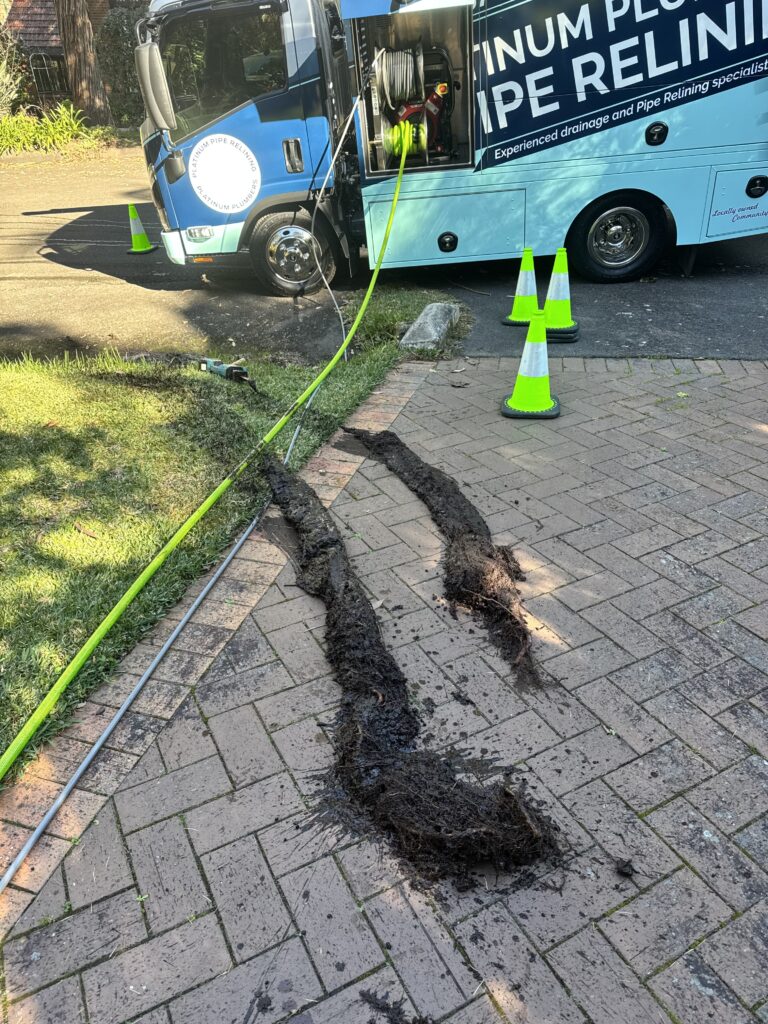
If you have ever wondered what a blocked drain actually looks like once we pull it out, here it is. This is a genuine root mass our team cleared from a Sydney stormwater line in Pymble this week, laid out across the driveway next. Nearly two metres of root growth, all of it living inside a pipe barely 100mm wide.
How does a tree root even get inside a stormwater pipe?
Pipes were never sealed against roots the way most people assume. Every join, every hairline crack, every slightly worn seal is an entry point. Tree roots do not force their way in. They find moisture inside the pipe and grow toward it, then squeeze through gaps as fine as a few millimetres. Once a root tip is inside, it thickens over months and years until it fills the pipe like the one in this photo, and once the flow slows down, silt and debris carried in with the rain start building up around it too.
Sydney’s older suburbs make this worse. Established gum trees, jacarandas and figs on Northern Beaches, North Shore and Inner West blocks often have root systems that have had 30 or 40 years to find every stormwater pipe joint on the property.
The warning signs before it gets this bad
Most homeowners do not see the blockage coming until it is already a problem, and often only during heavy rain. The signs are usually small at first:
- Water pooling in the yard or driveway during and after rain, especially near a stormwater pit or grate
- Slow-draining or overflowing gutters and downpipes even in moderate rain
- Water backing up out of a stormwater grate instead of flowing away
- Damp or unusually green patches over the pipe run that show up after wet weather
- The same low spot flooding every time it rains, even lightly
Any one of these on its own is worth a call. All of them together usually mean roots have already found their way in.
Why we do not just dig up the yard anymore
The old fix for root intrusion was to trench the yard, replace the damaged section of pipe, then repair the paving, lawn or garden bed on top. It worked, but it was expensive, slow and left a mess behind.
Pipe relining changes that. We run a CCTV camera through the line first to find exactly where the damage sits, jet out the roots and debris, then insert a resin-coated liner that cures in place to form a new pipe inside the old one. No trenching, no ripped-up pavers, no waiting weeks for landscaping to recover. In most cases the job is done in a day.
What to do if this looks familiar
If your yard floods when it rains or a stormwater grate keeps backing up, do not wait for it to look like the photo above. A CCTV inspection will tell you exactly what is happening underground and whether relining is the right fix, usually before any tree root gets anywhere near this size.
Book a CCTV drain inspection with Platinum Plumbers today. Servicing Sydney’s Northern Beaches, North Shore and Inner West, 24/7.
Is a stormwater drain the same as a sewer drain?
No. Stormwater drains carry rainwater runoff from your roof, gutters and yard away to the street system or a soakage point. Sewer drains carry wastewater from toilets, sinks and showers to the sewer main. They are separate pipe systems, though both can suffer root intrusion in the same way
Why do tree roots target stormwater pipes if there is no sewage in them?
Roots are chasing moisture, not waste. Stormwater pipes hold water after rain and often sit in damp soil, which is exactly what roots grow toward. Older stormwater pipes with clay or concrete joints are just as vulnerable as sewer lines.
Will this cause damage if I ignore it?
Yes. A blocked stormwater line has nowhere for rainwater to go, so it backs up onto paving, garden beds or even under the house during heavy rain. Left long enough, the trapped water and root pressure can crack the pipe further and undermine paving or foundations nearby.
How much does stormwater pipe relining cost?
It depends on the length and depth of the damaged section and how much access the site allows. We provide a fixed quote after the CCTV inspection, so you know the cost before any work starts.
How long does the fix take?
Most single-section relines are completed in a day. The liner cures in place within a few hours, and the drain can usually be back in service the same day.